From Emigration State to Immigration Crossroads: Policy Reform, Migrants, and the Paradox of Morocco's Nouvelle Politique Migratoire
Article Sidebar
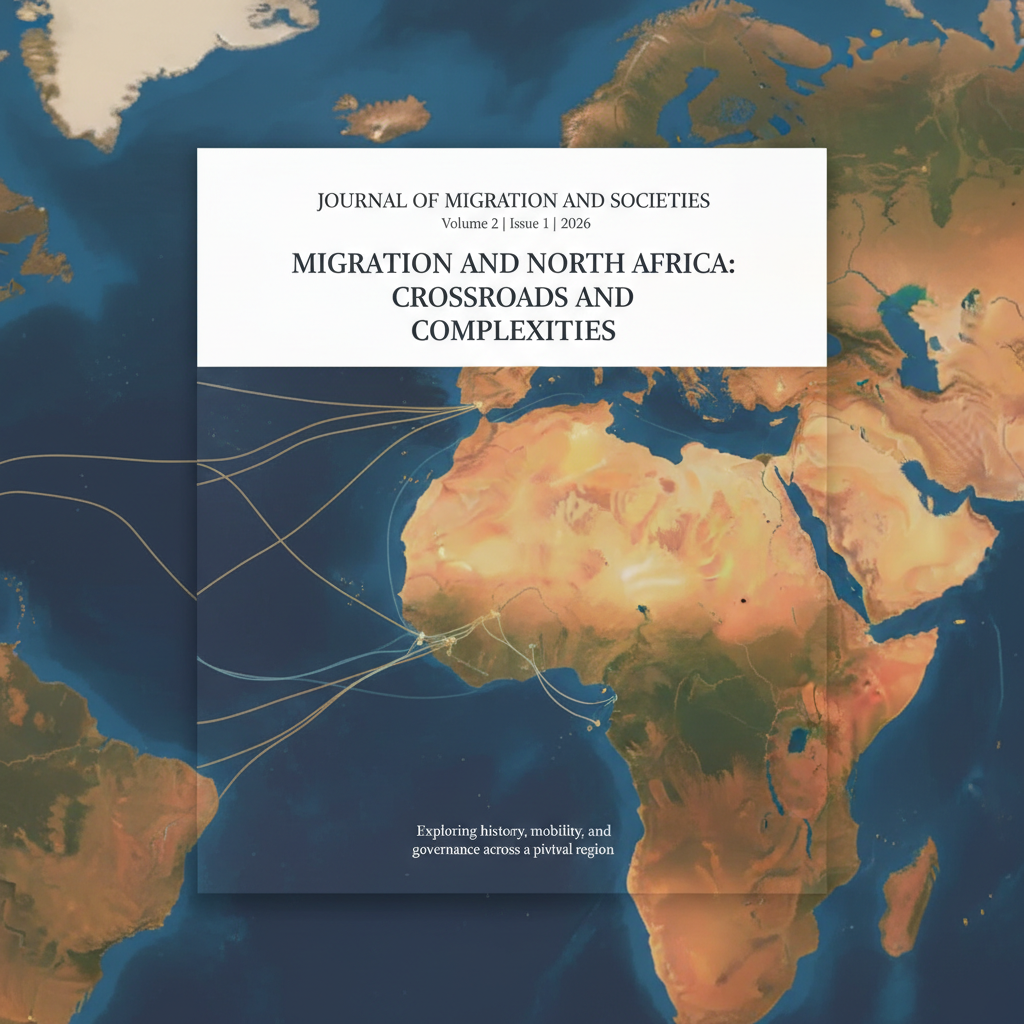
Main Article Content
Abstract
In September 2013, King Mohammed VI of Morocco delivered a throne speech that announced a fundamental reorientation of the Kingdom's approach to migration — an acknowledgement, remarkable in the North African regional context, that Morocco had become not merely a country of emigration and transit but a country of immigration in its own right, with corresponding obligations toward the sub-Saharan African migrants residing on its territory. The resulting Nouvelle Politique Migratoire (New Migration Policy), launched under royal impetus and implemented through two successive regularization campaigns in 2014 and 2017, represented the most ambitious migration policy reform in Moroccan history and attracted considerable international attention as a potential model for humane migration governance in the Global South. A decade on, however, the trajectory of Morocco's migration reform presents a far more ambivalent picture than its initial reception suggested: one in which genuine humanitarian commitments coexist with persistent securitization, in which formal policy advances are regularly undermined by documented abuses, and in which the structural drivers of sub-Saharan migration through and to Morocco — rooted in global inequality, climate vulnerability, and the externalization logics of European border policy — remain entirely unaddressed. This article offers a comprehensive decade-long assessment of Morocco's Nouvelle Politique Migratoire, examining the political origins of the reform, its institutional architecture, its implementation record, and the lived experiences of sub-Saharan African migrants in Morocco in the years since its announcement. The study draws on a multi-sited mixed-methods research design encompassing documentary and policy analysis of Moroccan state migration law and administrative records; thirty-two semi-structured interviews with Moroccan government officials, UNHCR and IOM representatives, and civil society organizations; and 134 in-depth interviews with sub-Saharan African migrants and recognized refugees in Rabat, Casablanca, Tangier, Nador, and Oujda conducted across three field research periods between 2016 and 2022. Theoretically, the article engages with the literature on migration policy reform in the Global South, the politics of humanitarian governance, and the concept of "migration diplomacy" to argue that Morocco's reform is best understood not as an autonomous humanitarian turn but as a strategic repositioning within the triangular political field defined by Moroccan domestic politics, EU-Morocco migration cooperation, and Morocco's ambitions for continental African leadership. While affirming the genuine material improvements that the regularization campaigns have produced for tens of thousands of migrants, the article documents the significant gap between the reform's stated principles and the ongoing reality of arbitrary detention, collective expulsions, racial profiling, and structural exclusion experienced by the majority of sub-Saharan Africans in Morocco who remain outside the formal protection system. The article concludes by examining the implications of Morocco's experience for theories of migration policy reform in the Global South and for the broader debate about whether rights-based migration governance is achievable within the current global architecture of migration control.
Downloads
Article Details
Section
References
Belguendouz, A. (2006). Expansion et sous-traitance des logiques d'enfermement de l'Union Européenne: L'exemple du Maroc. Cultures & Conflits, 57, 155–219.
Benharrousse, R. (2026). Denied personhood: The necropolitical production of disposability in Mediterranean migration. In Immunity and Community (pp. 75–96). Bloomsbury Publishing Plc. https://doi.org/10.5040/9798216380467.0009
Benharrousse, R. (2026). Lharba as politics of escape: Necropolitics, digital discourse and Moroccan youth migration. Journal of African Cultural Studies, 38(2), 207–233. https://doi.org/10.1080/13696815.2026.2665724
Benharrousse, R. (2025). The immigrant as other: Racial capitalism, neoliberalism, and necropolitics in Laila Lalami’s The Other Americans. Prague Journal of English Studies, 14(2), 173–194. https://doi.org/10.14712/23362685.5085
Boum, A., & Park, T. K. (2016). The Maghrib in question: Essays in history and historiography. University of Texas Press.
Brachet, J. (2012). Migrations transsahariennes: Vers un désert cosmopolite et morcelé (Niger). Mappe Monde, 9, 1–8.
Bürkner, H.-J. (2012). Intersectionality: How gender studies might inspire the analysis of social inequality among migrants. Population, Space and Place, 18(2), 181–195.
Cattedra, R., & Petti, A. (2019). Morocco's African policy. In Handbook of African politics (pp. 342–361). Routledge.
CNDH (Conseil National des Droits de l'Homme). (2013). Étrangers et migration: Pour une politique d'asile et d'immigration résolument humaniste. Royaume du Maroc.
Collyer, M. (2007). In-between places: Trans-Saharan transit migrants in Morocco and the fragmented journey to Europe. Antipode, 39(4), 668–690.
De Haas, H. (2007). The myth of invasion: The inconvenient realities of African migration to Europe. Third World Quarterly, 29(7), 1305–1322.
De Haas, H. (2008). Irregular migration from West Africa to the Maghreb and the European Union: An overview of recent trends. IOM Migration Research Series, No. 32.
Düvell, F. (2012). Transit migration: A blurred and politicized concept. Population, Space and Place, 18(4), 415–427.
Fassin, D. (2011). Humanitarian reason: A moral history of the present. University of California Press.
GADEM (Groupe Antiraciste d'Accompagnement et de Défense des Étrangers et Migrants). (2018). Coûts et blessures: Rapport sur les opérations des forces de l'ordre au nord du Maroc. GADEM.
GADEM & Human Rights Watch. (2022). "They pushed them to the ground": Accounts from the June 24 Melilla tragedy. GADEM/HRW Joint Report.
Human Rights Watch. (2006). Stemming the flow: Abuses against migrants, asylum seekers and refugees. Human Rights Watch.
Human Rights Watch. (2020). Morocco: Migrants, asylum seekers expelled. Human Rights Watch.
IOM (International Organization for Migration). (2015). The Moroccan migration policy: Review and perspectives. IOM Regional Office for the Middle East and North Africa.
IOM. (2018). Rapport sur la deuxième campagne de régularisation des étrangers au Maroc: Résultats et analyses. IOM Rabat.
Lahlou, M. (2005). Migrations irrégulières transnationales et action publique au Maroc. Revue Européenne des Migrations Internationales, 21(1), 9–40.
Lavenex, S., & Stucky, R. (2011). Partnering for migration and asylum: New options for the EU's external migration policy. In The EU's external migration policies in a changing world (pp. 116–133). European Institute for Public Administration.
MCMREAM (Ministère Chargé des Marocains Résidant à l'Étranger et des Affaires de la Migration). (2014). Campagne nationale de régularisation: Bilan et résultats. Gouvernement du Maroc.
Natter, K. (2014). The formation of Morocco's policy towards irregular migration (2000–2007): Political rationale and policy processes. International Migration, 52(5), 15–28.
Natter, K. (2018). Rethinking immigration policy theory beyond 'Western liberal democracies.' Comparative Migration Studies, 6(4), 1–21.
Üstübici, A. (2016). Political activism between journey and settlement: Irregular migrant mobilisation in Morocco. Geopolitics, 21(2), 303–324.
Üstübici, A., & Özler, Ş. İ. (2022). Negotiating bordering and belonging: Sub-Saharan Africans in Morocco. Ethnic and Racial Studies, 45(3), 500–520.
Walters, W. (2011). Foucault and frontiers: Notes on the birth of the humanitarian border. In U. Bröckling, S. Krasmann, & T. Lemke (Eds.), Governmentality: Current issues and future challenges (pp. 138–164). Routledge.
Wippel, S. (2013). Morocco between Europe and Africa: Geopolitical reorientation and its effects on migration policy. Journal of North African Studies, 18(5), 709–726.
Wunderlich, D. (2010). Differentiation and policy influence in EU external governance: The case of the EU's migration and asylum policies towards Morocco and Libya. European Foreign Affairs Review, 15(4), 549–570.